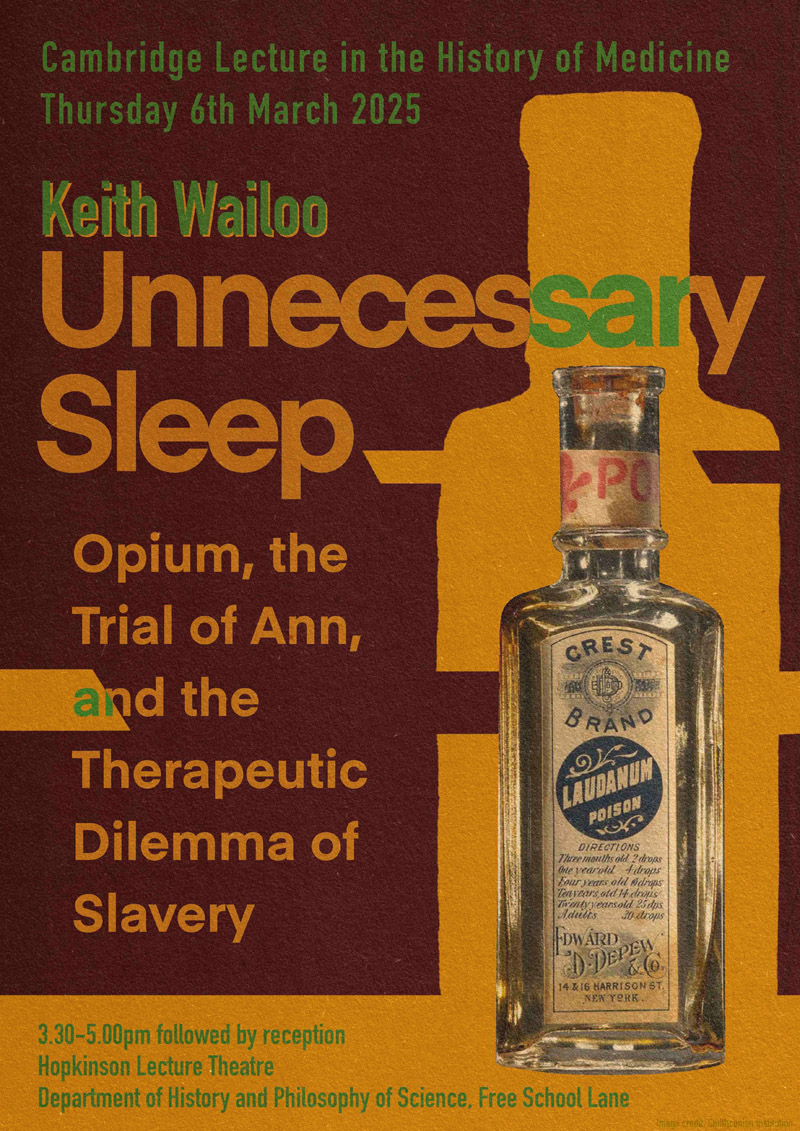

Keith Wailoo (Princeton University) gave the Cambridge Lecture in the History of Medicine on Thursday 6 March 2025 at 3.30–5.00pm in the Hopkinson Lecture Theatre. Prof. Wailoo also led an informal workshop at 11.30am the same day.
Lecture
Unnecessary sleep: opium, the trial of Ann, and the therapeutic dilemma of slavery
As global opium markets expanded in the 19th century, the drug presented a deep therapeutic dilemma. Valued for vanquishing pain and inducing sleep, opium also heightened fears about its habit-forming capacity. Prized amid recurring cholera epidemics, opium products also provoked worry over their capacity to poison and kill. This talk – previewing my next book – examines a single murder trial of an enslaved girl in 1850 Tennessee, accused of using opium to kill the infant child of her master. At issue in the case was her knowledge of the uses and misuses of laudanum, an opium concoction. The case sheds light on an unexplored aspect of the nineteenth-century opium dilemma – the interplay of vital need and fear of poisoning as manifest in the context of US slavery. The case also illuminates how the courts waded into this therapeutic dilemma – how law and medicine interacted in adjudicating questions of knowledge, intent, culpability, and the maintenance of social order as opium found its way onto the North American slave plantation.
Workshop
We discussed the following short pieces:
- 2016, 'Thinking Through the Pain', Perspectives in Biology and Medicine
- 2017, 'Sickle Cell Disease: A History of Progress and Peril', New England Journal of Medicine
- 2019, 'The FDA's Proposed Ban on Menthol Cigarettes', New England Journal of Medicine
- 2020, 'Spectacles of Difference: The Racial Scripting of Epidemic Disparities', Bulletin of the History of Medicine
About the lecturer
Keith Wailoo is Henry Putnam University Professor of History and Public Affairs at Princeton University. In 2021 he received the Dan David Prize for his "influential body of historical scholarship focused on race, science, and health equity; on the social implications of medical innovation; and on the politics of disease" and was also elected to the American Academy of Arts and Sciences. His most recent book is Pushing Cool: Big Tobacco, Racial Marketing, and the Untold Story of the Menthol Cigarette (Chicago, 2021), which received the 2023 Hughes Prize from the British Society for the History of Science for its "originality and timeliness ... incisive commentary ... [and] meticulous research to uncover the enmeshment of social sciences, racial exploitation, and corporate interests, with catastrophic consequences for public health in the United States".
Photo of Keith Wailoo by Sameer Khan, Fotobuddy.