The Museum has a wide range of publications giving in-depth information on areas of the collection. Publications are on sale in the Museum gallery or by mail-order via the website.
Publications that are out of print and are no longer available are listed on a separate page.

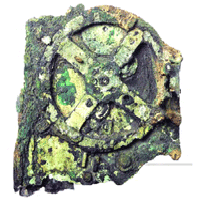
The Antikythera Mechanism: Decoding an ancient Greek mystery
Tony Freeth, 2008, 36pp
A brief history of research on the Antikythera Mechanism, written to accompany the exhibition which ran from July 31st - December 19th 2008 in the Whipple Museum. Tony Freeth, one of the team known as the Antikythera Mechanism Research Project [http://www.antikythera-mechanism.gr] (AMRP), gives a participant's account of conducting research into this extraordinary ancient Greek astronomical calculating machine.
The Mechanism was designed to calculate complex cycles of mathematical astronomy, including the movements of the sun, moon and planets. However, latest research by the AMRP reveals that it also contained a sporting calendar, with a dial showing the four-year cycle of ancient Greek athletic games, including the Olympic Games.
£3.00 plus postage and packing » How to order

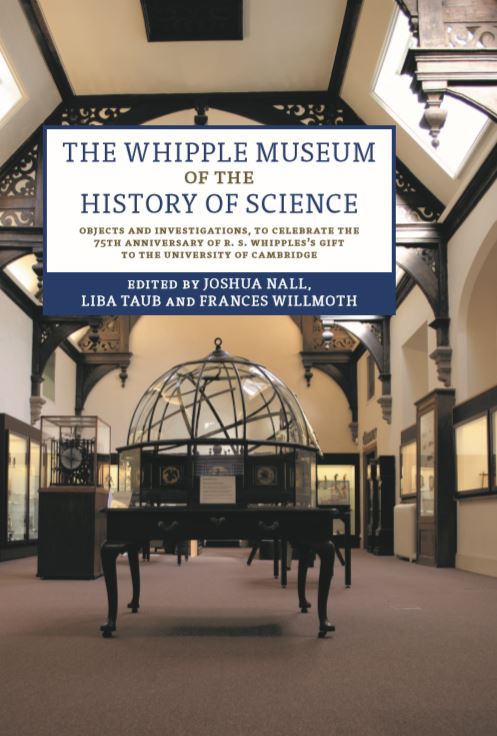
The Whipple Museum of the History of Science: Instruments and interpretations, to celebrate the 60th anniversary of R.S. Whipple's gift to the University of Cambridge
Liba Taub and Frances Willmoth (eds.), 2006, 512pp
The Whipple Museum in Cambridge contains one of the most important existing collections in the history and philosophy of science and has played a key role in teaching and research within those subjects. Founded in 1944 with funding from Robert Stewart Whipple, formerly of the Cambridge Scientific Instrument Company, the Museum aims to preserve the material culture of science through its collections, to document and provide access to those collections, and to interpret and research the material culture and associated practices of past science.
This volume brings together 23 essays and 85 illustrations which chart the Museum's history; examine its role and influence within the University of Cambridge and the study of the subject more widely; and focus on a range of particular scientific instruments in the collection, drawing out their broader historical significance and associations.
£35.00 plus postage and packing » How to order

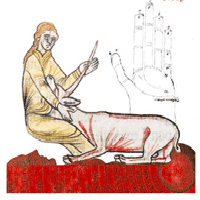
The Body as Instrument
Anke Timmermann, Nick Jardine and Debby Banham (eds.), 2006, 48pp
The Cambridge Latin Therapy Group's third booklet, discussing the different uses of the human body as an instrument in writings by the venerable Bede, Johannes Kepler, Robert Fludd, and the anonymous writers of a bestiary and lecture notes from sixteenth-century Vienna. The reader will encounter a maiden and a unicorn, Saint Anastasius, a dismembered hand and a protective medalet, but also be informed about Fludd's idea of the body as a monochord and Kepler's use of bodily imagery in his conception of the world and the cosmos. In itself an instrument of understanding, this publication presents texts and translations as well as notes and theories.
£3.00 plus postage and packing » How to order

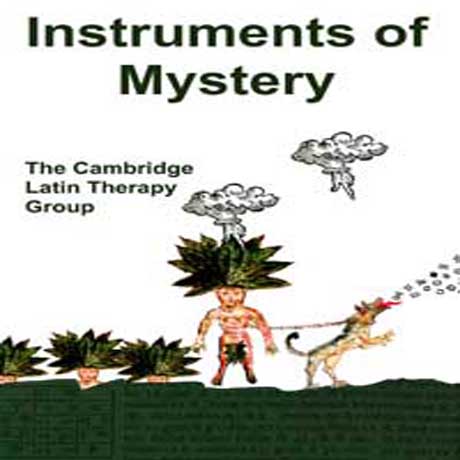
Instruments of Mystery
Catherine Eagleton and Patrick Boner (eds.), 2004, 65pp
A second booklet by the Cambridge Latin Therapy Group on problematic instrument texts, Instruments of Mystery tells how the group arrived at translations of three mysterious sources: a letter from Tycho Brahe ambiguously describing a planetary instrument that he had seen; a manuscript about a cunning device for uprooting a mandrake, without you or your dog being struck dead by its fearsome scream; and an arcane proposal for transmitting coded messages faster than the speed of time. Instruments of Mystery reflects on the status of these elusive instruments and on the ways in which translators can come to terms with the obscurities of such enigmatic, wondrous and inscrutable texts.
£3.00 plus postage and packing » How to order

Instruments of Translation
Catherine Eagleton, Jennifer Downes, Katherine Harloe, Boris Jardine, Nick Jardine, Adam Mosley, 2003, 54pp
This essay derives from meetings of the Cambridge Latin Therapy Group, a graduate seminar devoted to translating Latin texts on the history of science. We tell how the group arrived at translations of three sources relating to medieval and early modern time-measuring instruments: a manuscript on the use of the navicula sundial; instructions engraved on a 17th-century Rojas dial; and a description of a horological device in Athanasius Kircher's Ars magna lucis et umbrae (1646). We discuss how the difficulties encountered in translation should be represented in critical translations and editions. Our problems and successes in using instruments to interpret texts - and vice versa - show the value of dialogue between historians of books and historians of instruments.
£3.00 plus postage and packing » How to order

Representations of the Double Helix
Soraya de Chadarevian and Harmke Kamminga, 2002, 76pp
Images of the double helix are everywhere: in scientific publications and the media, in business advertisements, as a design for consumer goods, and in works of art. This catalogue presents a selection of the material included in the recent exhibition Representations of the Double Helix. With colour illustrations throughout, it follows the image of the double helix from its first appearances in scientific papers to its uses as a cultural icon.
£5.00 plus postage and packing » How to order

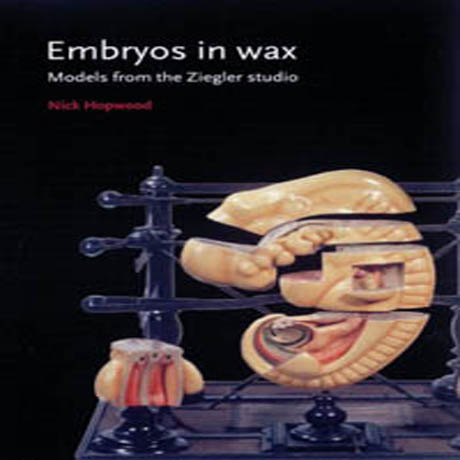
Embryos in Wax: Models from the Ziegler studio
Nick Hopwood, 2002, 216pp, including 32pp colour and 100 halftones
Embryos in Wax highlights the role of 3-D models in creating the images of embryos that we see today on our computer and television screens. It is about the extraordinary objects that in the 19th and early 20th centuries Adolf and Friedrich Ziegler cast for universities and museums around the world. A lavishly illustrated history, this is also a comprehensive guide to the finest embryological models.
More information on Embryos in Wax [http://www.hps.cam.ac.uk/embryos/Fpage.html]
£13.50 plus postage and packing » How to order
Your Humble Servant, John Flamsteed: Letters and writings of the first Astronomer Royal
Frances Willmoth, 2002, 20pp
A booklet to accompany the exhibition of the same name, featuring items from every stage of Flamsteed's long career as an astronomer and representing many facets of his unique achievement.
£1.50 plus postage and packing » How to order
Instruments in Print: Books from the Whipple Collection
Silvia de Renzi, 2000, 107pp
An illustrated selection of sixty books from the collection of rare books Robert Whipple bequeathed to the University of Cambridge. This publication investigates the range and use of printed material dealing with instruments. Topics covered include authorship, readership and use of such books.
£8.00 plus postage and packing » How to order
Between the Market and the Academy: Robert S. Whipple (1872-1953) as a collector of science books
Silvia de Renzi, 1998, 22pp Originally published in Robin Myers and Michael Harris (eds.), Medicine, Mortality and the Book Trade, St. Paul's Bibliographies, Oak Knoll Press, 1998, pp. 87-108
A biographical sketch of Robert Whipple including a profile of his book collection and the way he assembled it. This booklet also looks at the broader picture of the entry of science books into the antiquarian book market; the framework and network of collectors with whom Whipple was in contact and the dealers who supplied Whipple with his books.
£2.00 plus postage and packing » How to order
An University Within Ourselves: Sciences in Cambridge in the 18th century
Whipple Museum of the History of Science, 1998, 48pp
Despite the sleepy reputation of 18th-century Cambridge, many colleges were engaged in building facilities for astronomical research. From the observatory at Trinity College to the University Observatory in the early 19th century, Cambridge was never inactive. This booklet accompanies the exhibition mounted in the Whipple Museum to mark the two hundredth anniversary of the closing of Trinity Observatory in 1797.
£4.00 plus postage and packing » How to order
1900: The New Age
J.A. Bennett, R. Brain, S. Schaffer, H.O. Sibum, R. Staley, 1994, 101pp
Every age tries to define its future. 1900: The New Age takes you back to the International Exhibition held in Paris in 1900 to explore some visions of various imaginary 20th centuries, and how the past saw the future in its amazing and threatening present.
£5.00 plus postage and packing » How to order
Empires of Physics: A Guide to the Exhibition
J.A. Bennett, R. Brain, K. Bycroft, S. Schaffer, H.O. Sibum, R. Staley, 1993, 110pp
The exhibition explores how the combination of the Laboratory and the Exhibitions staged in European cities between the 1850s and 1900 made it seem that the world could be dominated by the products of physics.
£4.00 plus postage and packing » How to order
Going to the Fair: Readings in the culture of 19th-century exhibitions
Robert Brain, 1993, 198pp
This original anthology assembles materials culled from exhibition literature from the Great Exhibition of 1851 in London to the Paris Universal Exposition of 1900.
£8.00 plus postage and packing » How to order
A Decade of Accessions
J.A. Bennett, 1992, 64pp
Selected highlights of instruments acquired by the Whipple Museum between 1980 and 1990. Chosen and described by Dr Jim Bennett, curator of the Museum from 1978 to 1994.
£2.00 plus postage and packing » How to order
Catalogue 6: Sundials and Related Instruments
David J. Bryden, 1988, 108pp
A comprehensive guide to the sundials and related instruments housed within the Whipple Museum.
£7.50 plus postage and packing » How to order
Catalogue 8: Electrical and Magnetic Instruments
Kenneth Lyall, 1991, 136pp
A comprehensive guide to the electrical and magnetic instruments housed within the Whipple Museum.
£5.00 plus postage and packing » How to order
Le Citoyen Lenoir: Scientific instrument making in revolutionary France
J.A. Bennett, 1989, 35pp
A gallery full of French instruments, demonstrating the shift that took place between the 18th and 19th centuries, with Lenoir at the pivotal epoch of the French Revolution. A record of an exhibition in the Whipple Museum.
£5.00 plus postage and packing » How to order
From Pleasure and Profit to Science and Security: Etiene Lenoir and the transformation of precision instrument-making in France 1760-1830
A.J. Turner, 1989, 107pp
A first sketch of the life of Etienne Lenoir and of the radical changes which occurred in French instrument making between 1780 and 1830. This book accompanies the exhibition 'Le Citoyen Lenoir' at the Whipple Museum which marked the bicentenary of the French Revolution.
£6.00 plus postage and packing » How to order

The Ivory Sundials of Nuremberg 1500-1700
Penelope Gouk, 1988, 144pp
A comprehensive and inter-disciplinary study of the ivory diptych dials produced in Nuremburg in the period 1500-1700. This book places the dials in the cultural context in which they were manufactured and marketed. This extensively illustrated publication includes a catalogue of the exhibition of the same name.
£7.00 plus postage and packing » How to order
Selected Exhibits in the Whipple Museum of the History of Science
D. Bryden, 1978, 17pp
Selected highlights of instruments on display in the Whipple Museum, chosen and described by David Bryden, curator of the Whipple Museum from 1970 to 1978.
£1.00 plus postage and packing » How to order
Sphæra Mundi: Astronomy books 1478-1600
A 50th Anniversary Exhibition at the Whipple Museum of the History of Science
J.A. Bennett and D. Bertoloni Meli, 1994, 148pp
An illustrated catalogue produced to coincide with the Museum's 50th anniversary exhibition. Utilising books from the Whipple collection, it deals not only with bibliographical issues and with practical and technical aspects of the astronomy of the time, but also with such things as dedicatory letters, as a reminder of the importance of patronage in astronomical careers of the period.
£10.00 plus postage and packing » How to order
Science at the Great Exhibition
J.A. Bennett, 1983, 22pp
This illustrated booklet, published to accompany an exhibition of the same name, provides an account of the medals awarded to 'Class X: Philosophical Instruments' at the Great Exhibition, Crystal Palace, 1851.
£1.00 plus postage and packing » How to order
Astrolabes in the Whipple Museum Collection
Whipple Museum, 2006, 20pp
Booklet
£1.50 plus postage and packing » How to order
Objects of Natural History
Cambridge Group for the History of Natural History and the Environmental Sciences, Editors: H. Macdonald, F. Reid, 2008, 120pp
Containing the records and recipes of the Cabinet of Natural History.
£3.00 plus postage and packing » How to order
All plus postage and packing » How to order